|
||
|
TWN
Info Service on WTO and Trade Issues (Mar26/43) TWN MC14 Update No. 9 MC14
Collapses as U.S. Strategy Derails Yaoundé Negotiations
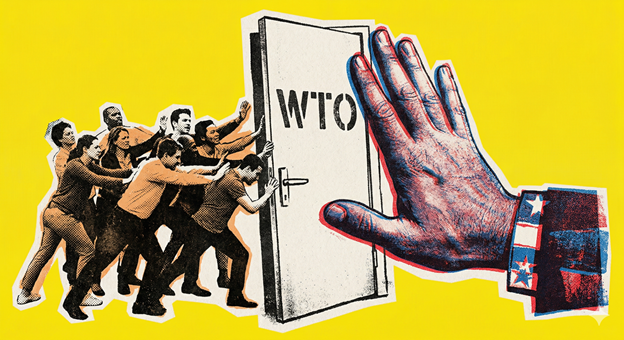
Kuala Lumpur*, Goh Chien Yen - The World Trade Organization’s 14th Ministerial Conference (MC14) in Yaoundé, Cameroon, ended on in the early hours of 30 March without a ministerial declaration or clear multilateral outcomes on the range of issues before ministers for decision. Ministers adopted a decision on Fisheries Subsidies** and two other decisions that were already endorsed earlier by members in Geneva: on integrating of small economies into the multilateral trading system; and on enhancing special and differential treatment provisions in the Agreements on Sanitary and Phytosanitary Measures (SPS) and Technical Barriers to Trade (TBT). Everything else was deferred to Geneva. MC14 now joins the list of failed WTO ministerials (Seattle in 1999, Cancún in 2003, Buenos Aires in 2017) that ended with a chair’s statement rather than agreed outcomes. The conference chair from Cameroon indicated that whatever emerges from continued negotiations would still be termed the “Yaoundé Package,” though for now that package is largely empty. According to participants from Africa, South America, and Asia, all speaking on background, the failure can be traced substantially to the negotiating strategy adopted by the United States. Washington made the e-commerce moratorium, specifically a permanent ban on customs duties on electronic transmissions, the centrepiece of its MC14 agenda, and linked progress on other issues to it. As one South American trade participant put it, the single issue of the e-commerce moratorium created such stress at the conference that everything became tied to it. Behind the scenes, the U.S. apparently pressured the African Group, stating it will extend AGOA (the African Growth and Opportunity Act) only if they agree to a permanent moratorium. The U.S. simultaneously pushed to dilute the reform agenda. In the lead-up to MC14, the reform package had already been streamlined in Geneva to accommodate U.S. concerns, but apparently not enough. Washington favoured a procedural-type outcome rather than substantive commitments, with reform to be carried out post-MC14 on the basis of individual members’ submissions. On agriculture, Members arrived in Yaoundé with what was already a slim draft text, having pared back their own positions to accommodate U.S. demands. One trade minister, without naming the U.S., complained that one member had sought to do away with 70% of that remaining text. Throughout the conference, Least Developed Countries (LDCs) underscored that food security was at stake. At the closing session, Brazil intervened to dispute the minister-facilitator’s report, arguing it did not reflect that a proposal close to the original text had been presented and could be brought to Geneva for adoption. On the e-commerce moratorium itself, Brazil objected to the text presented by the Jamaica minister (facilitator) at the final session on three grounds: a five-year extension would break the established practice (since 1998) of two-year renewals; there is still no agreed definition of “electronic transmissions”; and a longer moratorium would constrain the digital sovereignty and policy space of developing countries. Nonetheless, Brazil proposed to adjourn the matter to Geneva for further discussion, given that the ministerial conference had run out of time. Colombia, Bangladesh and India pushed for any extension on e-commerce to be linked to the TRIPS non-violation complaints (TNVCs) moratorium, which prevents WTO members from bringing non-violation complaints under the TRIPS Agreement on intellectual property. The TNVCs moratorium was due to expire at MC14. Colombia argued forcefully that it was incoherent for the e-commerce moratorium to continue receiving political attention while the TNVCs moratorium, an instrument Colombia framed as essential for public health, was allowed to lapse. Colombia proposed a three-to-six-month extension to allow continued work which was supported by many members including Bangladesh and Egypt. But the minister-facilitator on development reported that two members were not ready to approve an extension. No decision was recorded. In the end, the proposal to refer the e-commerce moratorium to Geneva was accepted by members during the closing session, with the Cameroonian Chair noting the linkage made with TNVCs. On the Investment Facilitation Agreement (IFA), the minister-facilitator reported simply that no consensus had been reached. The proposed incorporation did not succeed due to concerns that it was inconsistent with the WTO’s own rules as laid out in the Marrakesh Agreement. The conference process itself drew criticism. Multiple participants said the overall management of discussions was poor, with countries repeatedly stating they had concerns that went unaddressed. Most issues now return to Geneva for continued work, with the Director-General (DG) of the WTO urging members to accept the draft texts developed in Yaoundé to finalize agreements on outstanding issues at the next General Council meeting. According to the D-G they are: the draft Yaoundé Ministerial Declaration on WTO Reform and Work Plan; the draft Ministerial Decision on Electronic Commerce (which is “still missing some important numbers, the draft Ministerial Decision on the Moratorium on TRIPS Non-Violation and Situation Complaints; and the LDC package. However, the D-G also noted in her statement during the last informal heads of delegations meeting on the night of the 29th March “that the two moratoria and the e-commerce work programme will expire at the end of this month.” The substantive question is whether Geneva can deliver what Yaoundé could not. The U.S. strategy at MC14 was not an aberration. It reflected a consistent approach of lowering multilateral commitments while securing specific U.S. priorities. There is no indication this posture will change. The WTO’s 14th Ministerial Conference was supposed to demonstrate that the multilateral trading system could still produce results. Instead, it demonstrated how effectively a single member can prevent that from happening. *With inputs from TWN delegation at MC14, Yaoundé, Cameroon and “MC14 Ends Without Multilateral Outcomes on Reform, Agriculture, E-Commerce, IFDA blocked” Yaounde, 29 March (D Ravi Kanth). Statement by the Director-General at the Informal Heads of Delegation meeting March 29, 2026. **Correction. The Ministerial Decision on Fisheries Subsidies was adopted at MC-14.
|
||