|
|||
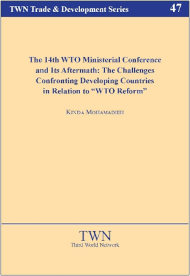
About the Book The 14th Ministerial Conference (MC14) of the World Trade Organization in March 2026 grappled with several difficult issues on its agenda – one of the most contentious and far-reaching of which was the question of “WTO reform”. As framed by developed countries like the US and the EU, reform of the trade body would undermine some of its fundamental tenets. Developed country proposals envision jettisoning the “most-favoured nation” (MFN) principle of non-discrimination and seek to prioritize plurilateral pacts among subsets of the WTO Membership at the expense of multilateral approaches and consensus-based decision-making. Special dispensations for developing countries, like special and differential treatment, would also be circumscribed, and restrictions on certain industrial policy tools tightened. These proposals stand in marked contrast to developing countries’ longstanding calls for reform of existing WTO rules which constrain their deployment of policy measures to achieve industrialization and structural economic transformation. With no outcome agreed at MC14, the future of WTO reform is up in the air. What is at stake in the continuing discussions is nothing less than the long-term direction of the WTO and the related implications for the economic advancement prospects of its developing Member states. ABOUT THE AUTHOR KINDA MOHAMADIEH is a legal advisor and senior researcher with the Third World Network office in Geneva. Her work focuses on WTO processes and negotiations, international investment governance, and issues of corporate legal accountability and business and human rights. She holds a PhD in international law from the Graduate Institute in Geneva, an LLM in international economic and commercial law from the University of Lausanne, and a master in public policy from the University of California at Los Angeles. Contents
Endnotes
|
|||